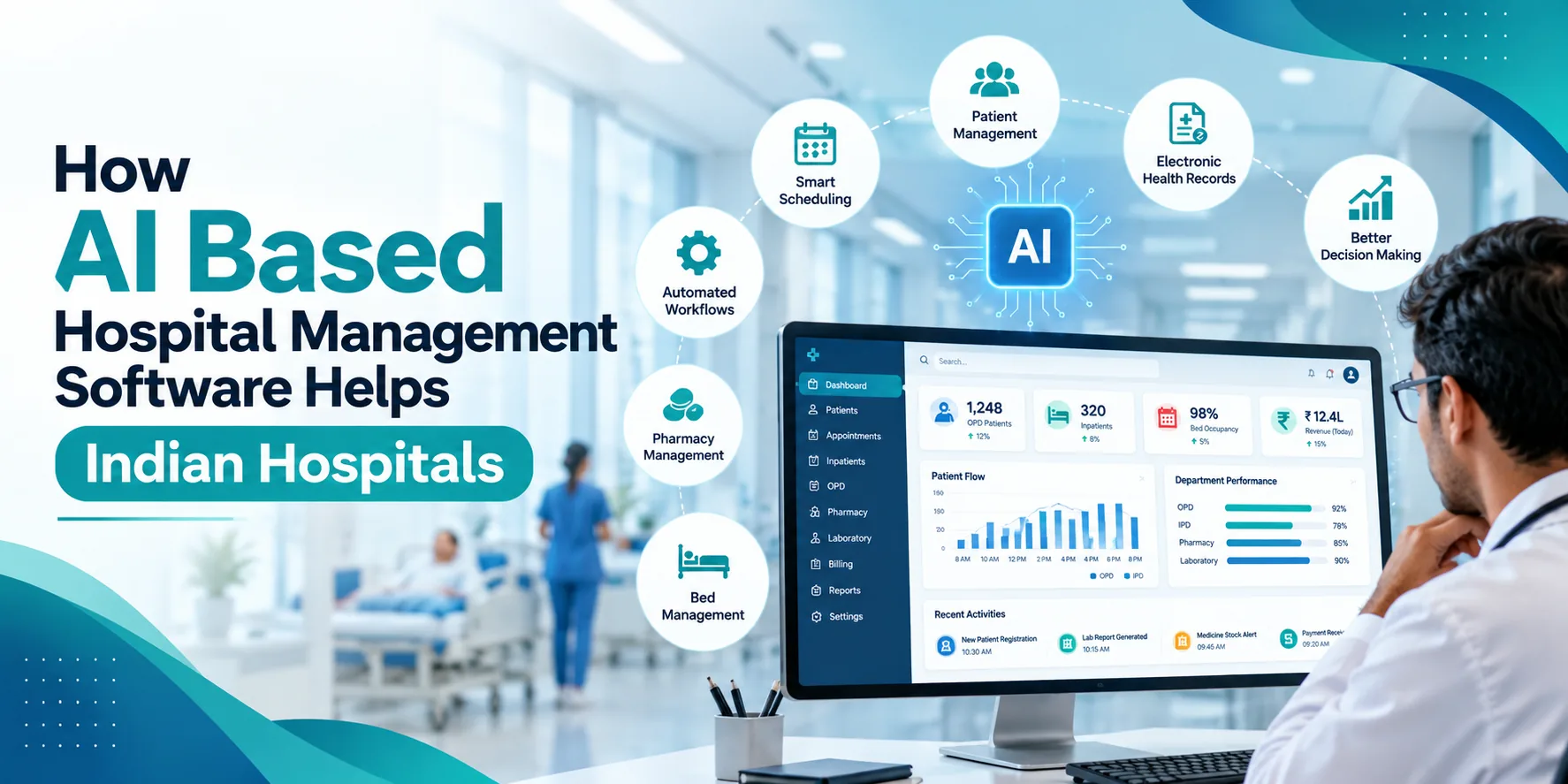
What Is AI Based Hospital Management Software?
AI based hospital management software is a digital platform that uses artificial intelligence, machine learning, predictive analytics, natural language processing, or intelligent automation to support hospital administration and selected clinical workflows.
A conventional hospital management system primarily records and processes information. An AI enabled system can also analyse relevant data to identify patterns, generate predictions, highlight potential problems, and recommend actions for authorised staff to review.
For example, a conventional appointment system records scheduled consultations. An AI enabled appointment system may analyse historical attendance patterns to estimate no show risk, identify periods of high demand, and help staff plan appointment slots more efficiently.
Similarly, a traditional inventory module records medicine stock. An AI powered inventory module may use historical consumption, current stock, supplier lead times, and seasonal demand to estimate future requirements.
The actual capabilities depend on the software, the quality of available data, and the way the AI features are configured.
How does AI hospital management software work?
Most AI enabled hospital management platforms follow a process that involves collecting relevant data, analysing it, generating insights, and supporting appropriate action.
- Data collection: The software receives information from registration, appointments, billing, electronic health records, laboratories, pharmacy systems, and other connected departments.
- Data processing: It organises information and checks whether the data is suitable for the intended task.
- AI analysis: Depending on the application, algorithms identify patterns, estimate demand, summarise information, or flag potential issues.
- Insight generation: The system presents predictions, alerts, recommendations, or summaries to authorised users.
- Human review: Doctors, nurses, administrators, or other responsible staff review the output and decide what action is appropriate.
- Performance monitoring: The hospital evaluates accuracy, usefulness, errors, and operational results over time.
Not every AI feature needs access to every hospital record. Access should be restricted to the information required for its specific purpose.
Why Do Indian Hospitals Need AI Powered Hospital Management Software?
Indian hospitals operate in different environments. A multispecialty hospital in a metropolitan city may manage large outpatient volumes, multiple diagnostic departments, intensive care units, and complex billing arrangements. A smaller hospital may have limited administrative staff, fewer IT resources, and a need to control operating costs.
Both types of facilities can benefit from better information management, although their requirements and budgets may differ.
Several operational challenges make AI enabled hospital software relevant.
1. Increasing patient volumes
Hospitals must coordinate appointments, consultations, diagnostic tests, admissions, and follow up visits. When these activities depend on manual coordination, delays and scheduling conflicts can occur.
AI assisted scheduling and demand forecasting can help hospitals understand busy periods and allocate available resources more effectively.
2. Repetitive administrative work
Staff may spend considerable time entering patient information, preparing summaries, checking documents, processing bills, and responding to routine enquiries.
Automation can reduce some of this repetitive work, provided the process is clearly defined and staff can review the results.
3. Fragmented patient information
When patient histories, laboratory results, prescriptions, and billing records are maintained in disconnected systems, staff may struggle to access the information they need.
An integrated hospital management platform can bring relevant information into a coordinated workflow. AI can then support specific tasks using that information, subject to permissions and data quality.
4. Resource planning difficulties
Hospital beds, operating theatres, diagnostic equipment, medicines, and staff hours must be managed carefully.
Predictive analytics can help estimate demand and identify potential bottlenecks before they become significant operational problems.
5. Need for better digital coordination
India's digital health initiatives encourage the development of connected healthcare services and interoperable health information systems. The National Informatics Centre'sNextGen eHospital initiative describes the role of modern hospital systems, digital health standards, and AI enabled capabilities in healthcare delivery.
For hospitals considering AI, this makes integration, standardisation, security, and long term system compatibility important parts of the software selection process.
12 Ways AI Based Hospital Management Software Helps Indian Hospitals
1. Automates patient registration and hospital administration
Patient registration is one of the first interactions between a hospital and its patients. Delays at this stage can affect appointment schedules, outpatient departments, and the overall patient experience.
AI enabled registration workflows can support staff by extracting information from approved documents, identifying possible duplicate patient records, classifying submitted forms, and checking whether required fields are missing.
For example, when a patient submits a registration form, document processing technology may extract the patient's name, contact information, and other relevant fields for verification. Staff can review the extracted information before saving it to the hospital database.
Intelligent automation can also help with routine administrative processes, including:
- Sorting incoming forms and documents.
- Identifying incomplete registration details.
- Routing administrative requests to the appropriate department.
- Preparing standard reports from verified system records.
- Sending appointment confirmations and administrative reminders.
- Reducing repeated data entry across connected modules.
These capabilities can help registration teams manage their workload more consistently.
Practical benefit: Hospitals may reduce manual data entry and administrative delays while improving the completeness of patient records. Results depend on document quality, workflow design, and staff review.
2. Improves hospital appointment scheduling
Appointment scheduling affects doctors, patients, reception staff, and diagnostic departments. Poor scheduling can create long queues, underused consultation slots, and delays in subsequent appointments.
AI powered hospital appointment scheduling software can analyse historical booking patterns, consultation duration, doctor availability, cancellations, and attendance records to help improve scheduling decisions.
Possible applications include:
- Forecasting periods of high appointment demand.
- Identifying appointment slots that are frequently underused.
- Estimating likely waiting times.
- Supporting cancellation management and waitlist coordination.
- Sending reminders through approved communication channels.
- Identifying patterns in missed appointments.
- Helping staff plan follow up consultations.
Consider a hospital where the outpatient department receives a large number of patients on Monday mornings. Historical booking data may help the scheduling system identify this recurring pattern and assist administrators in allocating suitable staff and appointment slots.
However, predicted appointment duration should not be treated as a guarantee. Emergencies, complex consultations, and unexpected clinical requirements can change schedules.
Practical benefit: Better scheduling can help reduce avoidable delays, improve slot utilisation, and make appointment management easier for hospital staff.
3. Supports electronic health records and patient management
Electronic health records (EHRs) allow authorised healthcare professionals to access relevant patient information digitally. AI can add value by helping staff organise and interpret information already available in the hospital's systems.
For example, natural language processing may assist with summarising lengthy clinical notes, extracting relevant details from documents, or organising information into structured fields.
Depending on the system, AI enabled patient management software may support:
- Summarising previous consultations.
- Organising clinical documentation.
- Identifying missing information in a record.
- Helping authorised users locate relevant patient history.
- Preparing draft clinical notes for review.
- Supporting continuity between departments.
- Identifying potential duplicate records.
Suppose a patient visits a hospital several times for a chronic condition. Instead of manually reviewing multiple lengthy notes, a doctor may be able to review an AI generated summary of previous visits, recorded medicines, investigations, and documented follow up plans.
The doctor must verify that the summary is accurate and complete. Important clinical information should never be omitted simply because an automated summary appears concise.
AI should also distinguish between information documented in the record and conclusions that have not been clinically established.
Practical benefit: Properly implemented EHR and AI tools can help authorised staff access relevant information more efficiently and reduce documentation burdens.
4. Helps doctors with clinical decision support
Clinical decision support systems provide relevant information to healthcare professionals during clinical workflows. AI enabled systems may analyse structured clinical data and identify patterns that warrant review.
Depending on their intended use and validation, these systems may assist with:
- Flagging potentially important changes in recorded observations.
- Identifying possible medication conflicts.
- Highlighting documented allergies.
- Supporting the review of laboratory results.
- Identifying missing information required by a clinical protocol.
- Presenting relevant evidence or clinical guidelines.
- Prioritising cases for review under an approved workflow.
For example, a clinical decision support system may flag a recorded medication combination for a pharmacist or doctor to review. The responsible professional can evaluate the patient's complete medical history, current treatment, and clinical circumstances before deciding whether any action is necessary.
It is important to understand that AI generated alerts are not automatically correct. Poorly configured alerts can create unnecessary warnings, while an inaccurate model may fail to flag a genuine concern.
AI based hospital software should therefore support professional judgement rather than independently determine diagnoses or treatment plans without appropriate clinical oversight.
Practical benefit: Clinical decision support may help clinicians find relevant information and identify potential risks, subject to the quality and validation of the system.
5. Improves hospital bed management and patient flow
Bed availability is an important operational concern, particularly in hospitals with emergency departments, intensive care units, surgical services, and high inpatient volumes.
Effective bed management requires coordination between admissions, nursing teams, doctors, housekeeping, billing, and discharge planning.
AI powered bed management tools can analyse historical admissions, average length of stay, planned procedures, current occupancy, and discharge patterns to help administrators anticipate demand.
Potential uses include:
- Forecasting inpatient bed requirements.
- Identifying periods when occupancy may become high.
- Supporting the allocation of appropriate beds.
- Tracking the status of beds awaiting cleaning or preparation.
- Identifying delays in patient transfer.
- Supporting discharge coordination.
- Providing a central view of bed availability across departments.
For instance, if historical records show that inpatient demand often increases during a particular period, the hospital may use that information to review staffing, bed preparation, and admission planning.
These predictions should be treated as planning estimates, not as guarantees of future occupancy.
Practical benefit: Better visibility into bed availability can help hospitals coordinate admissions and transfers, reduce avoidable bottlenecks, and use existing capacity more effectively.
6. Optimises pharmacy inventory and medicine stock
Pharmacy inventory management involves balancing medicine availability, expiry dates, purchase costs, storage conditions, and changing patient demand.
Stock shortages may interrupt routine operations, while excessive purchasing can tie up working capital and increase the risk of expired stock.
AI assisted pharmacy inventory management software can analyse historical consumption, current inventory, outstanding purchase orders, supplier lead times, and seasonal patterns.
Its possible capabilities include:
- Forecasting medicine requirements.
- Flagging medicines approaching their expiry dates.
- Identifying products with unusually high or low consumption.
- Supporting reorder recommendations.
- Detecting possible discrepancies in stock movement.
- Helping staff review slow moving inventory.
- Generating reports for pharmacy managers.
For example, a hospital pharmacy may use historical consumption and current stock levels to estimate whether an essential medicine needs to be reordered before its expected demand period.
Reorder recommendations should account for supplier reliability, storage requirements, minimum stock policies, and the clinical importance of each medicine. Automated systems must not make unsafe substitutions or override authorised pharmacy procedures.
Practical benefit: Better inventory visibility and demand forecasting can help reduce avoidable stockouts, manage expiry related losses, and support more informed purchasing decisions.
7. Supports laboratory and diagnostic workflow management
Hospital laboratories and diagnostic departments process requests from multiple clinical units. Delays in sample collection, testing, validation, or report delivery can affect subsequent decisions and patient flow.
AI can support diagnostic operations by helping staff manage workflows and identify patterns that require attention.
Possible applications include:
- Predicting laboratory workload.
- Identifying tests that are approaching internal turnaround time limits.
- Routing tasks to the appropriate department.
- Checking records for missing administrative information.
- Supporting quality control analysis.
- Assisting with the organisation of diagnostic reports.
- Integrating verified results into the patient's digital record.
AI systems specifically designed and validated for medical imaging or other diagnostic tasks may provide additional assistance. Such capabilities are different from general hospital administration features and may require separate validation, regulatory assessment, and clinical governance.
For example, an operations dashboard might flag a pending laboratory report that has exceeded the department's expected processing time. Staff can investigate the delay and take appropriate action.
Practical benefit: AI assisted workflow management can improve visibility into pending investigations and help departments identify operational delays.
8. Improves billing, insurance coordination, and revenue cycle management
Hospital billing involves several connected activities, including service recording, charge capture, invoice preparation, insurance documentation, claim submission, payment tracking, and reconciliation.
Manual errors or incomplete documentation can lead to rework and delayed payments.
AI assisted hospital billing software can help identify unusual billing patterns, missing fields, possible duplicate entries, and incomplete claim documents before they proceed to the next stage.
Depending on its configuration, it may also support:
- Automated extraction of billing information from approved documents.
- Matching invoices with recorded services.
- Flagging possible duplicate charges for review.
- Identifying missing insurance documentation.
- Categorising common claim rejection reasons.
- Preparing payment and outstanding balance reports.
- Forecasting expected cash flows from historical data.
For hospitals working with insurance providers or third party administrators, these features may help billing teams identify documentation problems earlier.
However, a flagged charge is not necessarily incorrect, and an automated claim recommendation should not replace contractual, clinical, or regulatory checks.
Practical benefit: AI can help reduce avoidable administrative rework, improve billing visibility, and support more consistent revenue cycle processes.
9. Helps hospitals manage staff and operational resources
Hospital operations depend on the coordinated availability of doctors, nurses, technicians, reception staff, support workers, and specialised equipment.
Staffing needs can vary according to appointment volumes, emergency demand, surgical schedules, seasonal patterns, and patient acuity.
AI driven workforce analytics can use historical activity data to help administrators estimate workload and identify potential staffing gaps.
Possible applications include:
- Forecasting outpatient department demand.
- Estimating staffing requirements by shift.
- Identifying recurring periods of excessive workload.
- Supporting staff scheduling within approved rules.
- Analysing equipment utilisation.
- Identifying operational bottlenecks.
- Helping managers compare planned and actual resource use.
For example, a hospital may find that certain diagnostic services experience higher demand during specific hours. Historical data can help administrators review shift patterns and resource allocation.
Staff scheduling recommendations must respect professional qualifications, duty hours, applicable labour requirements, rest periods, and patient safety needs. AI should not make staffing decisions solely on the basis of cost reduction.
Practical benefit: Better operational forecasting can help hospitals use staff and equipment more efficiently while maintaining appropriate service coverage.
10. Strengthens patient communication and follow up management
Patient communication continues after registration, consultation, and discharge. Patients may need appointment reminders, instructions, follow up visits, reports, or information about administrative procedures.
AI assisted communication tools can help hospitals handle routine enquiries and deliver approved information through suitable channels.
Examples include:
- Answering common questions about hospital services.
- Providing appointment confirmations.
- Sending follow up reminders.
- Sharing approved preparation instructions for tests.
- Directing patients to the appropriate department.
- Helping staff prepare responses in supported languages.
- Identifying unanswered administrative enquiries.
Indian hospitals often serve patients who prefer different languages. Depending on its quality and supported languages, a language processing tool may help staff communicate routine information in English, Hindi, Gujarati, or other regional languages.
However, translation accuracy must be assessed carefully, particularly for medical instructions. A general purpose chatbot should not independently diagnose symptoms, promise treatment outcomes, or provide emergency triage without an appropriately designed and validated clinical workflow.
Hospitals should offer a clear way to reach a human staff member when a question requires individual attention.
Practical benefit: Well designed communication tools can reduce repetitive enquiries and help patients receive timely administrative information.
11. Supports hospital quality monitoring and patient safety
Hospitals need reliable processes for monitoring service quality, reviewing incidents, and identifying opportunities to improve care.
AI assisted analytics can help quality teams examine trends across operational and clinical records, provided the data is suitable and the analysis is properly governed.
Potential applications include:
- Tracking waiting times and service delays.
- Monitoring readmission patterns for further investigation.
- Identifying recurring documentation gaps.
- Analysing incident reports.
- Reviewing compliance with defined workflows.
- Flagging unusual operational patterns.
- Supporting quality improvement dashboards.
For example, a hospital may observe that discharge delays are frequently associated with pending documentation or coordination between departments. Operational analysis can help the team identify the underlying process problem.
A statistical association does not establish that one factor caused another. AI findings should prompt investigation rather than be treated as proof of negligence, poor performance, or clinical error.
Practical benefit: AI enabled quality analytics can help hospital teams identify recurring problems and prioritise improvements using measurable evidence.
12. Provides management dashboards and predictive analytics
Hospital administrators need timely information about patient volumes, occupancy, revenue, costs, appointment demand, inventory, and departmental performance.
Traditional reports often describe what has already happened. Predictive analytics can add estimates of what may happen next, while prescriptive tools may suggest possible actions.
AI based hospital management software can support three useful forms of analysis:
Descriptive analytics: Shows what happened, such as monthly admissions, average waiting times, or medicine consumption.
Predictive analytics: Estimates what may happen, such as expected patient demand, possible stock shortages, or likely appointment cancellations.
Prescriptive analytics: Compares potential actions, such as adjusting appointment capacity or reviewing reorder quantities, within the system's defined capabilities.
For example, an administrator may use a dashboard to compare actual and predicted outpatient demand. If demand is likely to exceed planned capacity, the team can review available staff, appointment slots, and diagnostic resources.
Predictions are only as reliable as the underlying data and model. Hospitals should monitor how well forecasts perform and update them when operating conditions change.
Practical benefit: AI enabled dashboards can help hospital leaders make more informed operational decisions and identify issues earlier.