What Is Smart Pharmacy Management?
Smart pharmacy management is an approach to managing hospital pharmacy operations through connected digital systems, structured workflows and operational data.
It combines several activities that are often handled separately:
- Prescription management and dispensing
- Medicine inventory and batch tracking
- Expiry monitoring and stock rotation
- Purchase and supplier management
- Pharmacy billing and patient transactions
- Department-wise medicine consumption
- Pharmacy performance reporting
- User access and transaction accountability
The main difference between traditional pharmacy software and smart pharmacy management is the way information moves between these activities.
A basic billing application may record a medicine sale and generate an invoice. A connected pharmacy management system can also update the relevant stock quantity, preserve batch information, connect the transaction with patient billing and make the movement available for reporting.
For hospital administrators, this distinction matters because pharmacy performance depends on more than the speed of billing. It also depends on medicine availability, accurate records, procurement decisions and coordination with clinical departments.
A genuinely smart pharmacy should help management answer three important questions:
- What is happening? Which medicines are available, dispensed, purchased, returned or approaching expiry?
- Why is it happening? Which departments are consuming more stock? Why are particular products moving slowly? Where are discrepancies occurring?
- What should happen next? Should the pharmacy reorder, transfer stock, review purchasing patterns or investigate an unusual transaction?
The objective is to turn everyday pharmacy transactions into useful operational information.
Why Hospitals Need Connected Pharmacy Operations
A hospital pharmacy interacts with several departments throughout the patient journey. Doctors prescribe medicines, pharmacists review and dispense them, nursing teams administer prescribed treatments, procurement teams maintain supply, and finance departments manage billing.
If these activities rely on separate records, employees may need to enter the same information more than once.
Consider a common hospital situation.
A doctor prescribes a medicine for an admitted patient. The pharmacy receives the order, issues the medicine and records the transaction. However, if the pharmacy and hospital billing systems are disconnected, another employee may need to enter the same medicine details into the patient's account.
This creates additional work and introduces opportunities for mismatched quantities, incorrect charges or incomplete records.
Other common operational challenges include:
- Unreliable stock visibility: Different counters maintain separate records, making it difficult to identify actual available quantities.
- Expiry-related losses: Medicines remain unnoticed in storage because batch and expiry information is not reviewed regularly.
- Delayed procurement: Purchase decisions depend on manual stock checks rather than consumption and supplier lead-time information.
- Prescription communication gaps: Updated medication instructions may not reach the pharmacy through a consistent workflow.
- Billing discrepancies: Medicine issues, returns and patient charges may not reconcile properly.
- Limited management visibility: Pharmacy managers cannot easily identify slow-moving products, unusual consumption or department-level demand.
Connected pharmacy management addresses these issues by maintaining consistent records across relevant workflows.
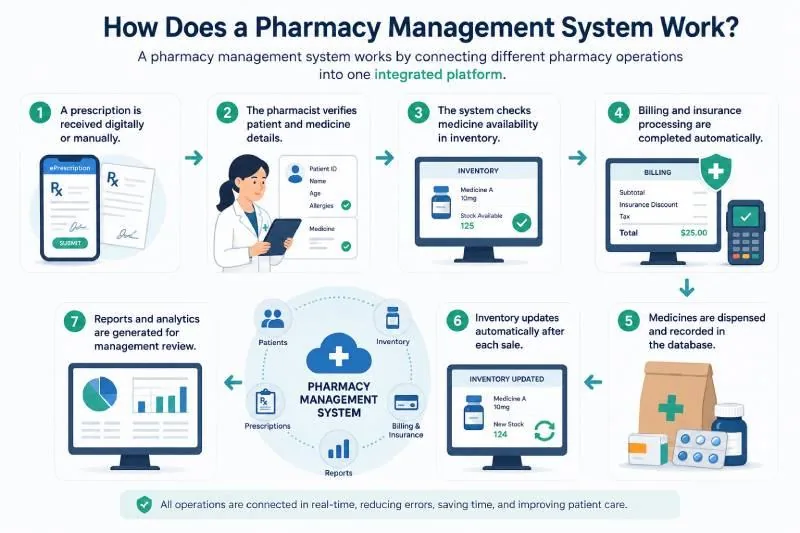
How a Smart Pharmacy Management System Works
The best way to understand smart pharmacy management is to follow a medicine through a hospital.
Visual 1 · Prescription-to-dispensing workflow
Step 1: Prescription creation. The treating doctor creates an electronic prescription or medication order through the hospital's EMR. It contains relevant patient and medication information, including the prescribed medicine and dosage instructions.
Step 2: Prescription reaches the pharmacy. The pharmacy receives the prescription through the connected workflow. The pharmacist reviews the order and checks the available information before proceeding.
Step 3: Medicine and batch verification. The pharmacist checks medicine availability, batch details and expiry information. Any clinical alerts or substitution rules available in the configured system can support the verification process.
Step 4: Dispensing and inventory update. After the medicine is issued, the corresponding stock movement is recorded. The inventory balance reflects the transaction according to the system's configured workflow.
Step 5: Patient billing. For integrated hospital workflows, the medicine issue can be reflected in the relevant OPD or IPD billing record without requiring a second manual entry.
Step 6: Management reporting. The transaction becomes part of pharmacy reporting. Management can review medicine consumption, stock movement, sales, margins and other available operational metrics.
This workflow creates a connection between the clinical order, pharmacy transaction, inventory ledger and financial record.
Essential Components of Smart Pharmacy Management
A hospital pharmacy management system should be evaluated by how well its modules work together, rather than by the number of features listed in a brochure.
1. EMR-Connected Prescription Management
Electronic prescription integration reduces dependence on manually transferring medication instructions between departments.
When doctors create prescriptions through an EMR software workflow, relevant information can reach the pharmacy through the connected system.
Important capabilities to evaluate include:
- Prescription transfer from clinical systems
- Patient and encounter identification
- Medicine and dosage information
- Prescription status tracking
- Drug interaction alerts where supported
- Substitution rules and approval workflows
- Updated prescription handling
An important implementation question is how the system handles a prescription change. If a doctor modifies a medication order, the pharmacy should have a defined process for identifying the latest valid order and handling any earlier dispensing activity.
Software alerts should support pharmacist verification, not replace professional clinical judgment.
2. Real-Time Medicine Inventory Management
Inventory accuracy directly affects medicine availability and purchasing decisions.
A hospital may maintain thousands of medicine SKUs across a central medical store, inpatient pharmacy, outpatient counter and specialized departments.
A connected pharmacy stock management system should maintain stock visibility across these locations.
Useful capabilities include:
- Stock tracking by medicine and SKU
- Batch-level inventory records
- Store and rack identification
- Stock inward and outward transactions
- Purchase and return records
- Low-stock notifications
- Stock adjustments and reconciliation
- Inter-store transfers
Every movement should have an identifiable transaction record. When a medicine is received against a purchase order, the system should record the received quantity and relevant batch details. When the medicine is issued, the corresponding quantity should be deducted from the appropriate inventory record.
This creates a more reliable basis for stock reconciliation.
3. Batch and Expiry Management
Tracking medicines only by product name and quantity is insufficient for hospital pharmacy operations.
Different batches of the same medicine can have different manufacturing dates, expiry dates, suppliers and purchase costs.
Batch-level inventory management helps pharmacy teams identify which stock is available, which batches are approaching expiry and which quantities should not be issued.
One important principle is FEFO (First Expiry, First Out). FEFO prioritizes the batch with the earliest expiry date, provided it is otherwise suitable for dispensing and meets the applicable storage and handling requirements.
This differs from FIFO (First In, First Out), which prioritizes the earliest received stock.
| Batch | Received date | Expiry date | Quantity |
|---|---|---|---|
| Batch A | 5 January | September 2027 | 100 |
| Batch B | 20 February | June 2027 | 80 |
| Batch C | 10 March | December 2027 | 120 |
Visual 2 · FEFO versus FIFO
Although Batch A arrived first, Batch B expires earlier. Under FEFO, Batch B would generally be prioritized for issue.
Expiry alerts, batch reports and stock rotation procedures can help pharmacies reduce avoidable expiry losses.
4. Automated Procurement and Replenishment
Purchasing medicines without reviewing current consumption, existing inventory and outstanding orders can lead to overstocking or stock shortages.
A structured procurement workflow should connect inventory information with purchase planning.
Important components include purchase requisitions, purchase orders, supplier and vendor records, purchase price comparisons, Goods Received Notes (GRN), invoice verification and purchase returns.
Consider a medicine that sells an average of 20 units per day. Its supplier normally takes five days to deliver, and the pharmacy maintains 30 units as safety stock.
In this example:
When the inventory position approaches 130 units, the pharmacy should review replenishment.
The inventory position should account for usable stock, committed quantities and outstanding purchase orders. Otherwise, a pharmacy might purchase medicines that are already on the way.
The reorder point is a planning trigger, not an instruction to place an automatic order without review.
5. Pharmacy Billing and Hospital Integration
Hospital pharmacies manage different types of medicine transactions, including outpatient sales, inpatient issues, discharge prescriptions and other authorized dispensing activities.
A connected billing workflow can link medicine issues with the relevant patient account and inventory record.
Hospitals should evaluate whether their software supports retail or counter-based billing, OPD pharmacy transactions, IPD medicine issues, patient-wise medicine records, sales and return transactions, configurable tax and discount rules, and integration with hospital billing.
For Indian deployments, GST-related invoicing and applicable pharmacy requirements should be configured according to the organization's operating model and current regulations. International hospitals must also assess local tax, reimbursement, prescription and medicine-record requirements.
6. Multi-Location Pharmacy Management
Hospitals with multiple pharmacy counters or central medical stores need a consistent view of stock across their locations.
For example, a central pharmacy may have sufficient quantities of a medicine while an inpatient unit is experiencing a shortage. A multi-location system can help authorized teams review stock availability and arrange an appropriate transfer instead of placing an unnecessary new order.
Useful capabilities include centralized inventory visibility, inter-store transfers, location-based permissions, transfer records and consolidated reporting.
7. Pharmacy Analytics and Reporting
Pharmacy reporting should help management understand operational performance, not simply show the total number of transactions.
Useful reports include medicine consumption by department, fast-moving and slow-moving products, expiry and near-expiry stock, inventory turnover, product-wise margins, purchase and sales trends, supplier performance and stock adjustment history.
These reports allow pharmacy managers to identify patterns and investigate exceptions before they become larger operational problems.
How Smart Pharmacy Management Supports Medication Safety
Medication safety requires coordination between doctors, pharmacists, nurses, patients and hospital systems.
WHO's Medication Without Harm initiative highlights high-risk situations, polypharmacy and transitions of care as important areas for reducing medication-related harm.
A pharmacy management system can support this work through structured prescription records, medication information, verification workflows and transaction traceability.
For example, a pharmacist reviewing a prescription may need to confirm the medicine, dosage instructions, available strength and relevant patient information. Where supported and correctly configured, interaction alerts and substitution controls can provide additional information during this review.
Batch tracking also helps identify which stock was issued during a particular transaction.
In India, the Drugs and Cosmetics Rules include specific recordkeeping requirements for Schedule H1 medicines. The 2013 amendment to Rule 65 requires a separate register recording specified prescriber, patient, drug and quantity details, with records retained for three years.
Digital systems can help organize such information, but hospitals must verify that their actual records, workflows and retention policies meet the applicable legal requirements.
How Hospitals Can Improve Pharmacy Inventory Control
A pharmacy needs more than a minimum stock quantity to manage medicines effectively. Different products have different consumption patterns, costs, clinical importance and supply risks.
Three practical inventory methods are particularly useful.
ABC analysis classifies inventory according to annual consumption value:
- A items: Higher annual consumption value and closer financial control.
- B items: Intermediate consumption value.
- C items: Lower annual consumption value.
VED analysis considers clinical criticality:
- Vital: Shortage may create serious clinical consequences.
- Essential: Important medicines that should remain available.
- Desirable: Medicines with lower criticality in the classification framework.
ABC-VED matrix combines these methods to help pharmacy managers consider both financial exposure and clinical importance.
Visual 3 · ABC-VED inventory prioritization matrix
For example, a medicine with a high annual consumption value and vital clinical importance requires close monitoring. A lower-cost but clinically vital medicine may also need stronger availability controls than its purchase value alone would suggest.
The objective is to prioritize inventory management based on both cost and patient-care requirements.
Pharmacy KPIs Every Hospital Should Monitor
Hospital pharmacy managers should review a small set of meaningful indicators regularly.
| KPI | Calculation or measurement | Management purpose |
|---|---|---|
| Inventory turnover | Cost of goods consumed ÷ Average inventory value | Understand stock utilization |
| Stockout rate | Unavailable medicine requests ÷ Total medicine requests × 100 | Identify availability problems |
| Expiry loss percentage | Value of expired stock ÷ Total inventory value × 100 | Monitor expiry-related losses |
| Gross margin | (Net sales − Cost of goods sold) ÷ Net sales × 100 | Review financial performance |
| Days of inventory on hand | Average inventory value ÷ Average daily consumption cost | Understand inventory coverage |
| Supplier lead time | Days between order placement and receipt | Improve procurement planning |
| Slow-moving stock | Products with no or limited movement during a defined period | Identify excess inventory |
The measurement period and calculation rules should remain consistent. Hospitals should also distinguish physical inventory, available inventory and inventory committed to pending patient orders.
For example, a low stockout rate does not necessarily mean inventory is being managed efficiently if the hospital is holding excessive stock. Management must evaluate availability, expiry losses and working capital together.
How to Choose the Right Hospital Pharmacy Management System
Selecting pharmacy software requires more than checking whether a vendor offers inventory and billing modules. Hospital administrators should evaluate the actual workflows that the software can support.
- Clinical integration: Can prescriptions reach the pharmacy from the hospital's EMR or HIS? How are updated and cancelled orders handled?
- Inventory accuracy: Does the system support SKU-level and batch-level tracking, expiry monitoring and stock reconciliation?
- Procurement workflows: Can pharmacy teams manage vendors, purchase orders, GRNs and outstanding deliveries?
- Billing integration: Can medicine issues be reflected in the relevant patient billing workflow?
- Reporting: Can management review medicine consumption, margins, stockouts and expiry-related losses?
- Security and accountability: Does the system provide role-based permissions and transaction logs? What authentication, backup and recovery controls are available?
- Scalability: Can the system support additional stores, hospital departments and transaction volumes?
- Local requirements: Can the deployment be configured for relevant tax rules, medicine classifications, privacy obligations and record-retention requirements?
- Implementation and support: What training, migration, configuration and integration assistance does the vendor provide?
A practical evaluation should include a demonstration using real hospital scenarios rather than a presentation of isolated software screens.
How MediTale Supports Connected Pharmacy Operations
MediTale's pharmacy management solution is designed to connect pharmacy workflows with broader healthcare operations.
Rather than treating billing, stock management and prescription handling as separate activities, its published capabilities cover the movement of information between clinical, inventory and administrative workflows.
EMR-linked prescriptions
The published pharmacy solution describes direct prescription flow from doctors, with dosage instructions and interaction alerts. This supports coordination between prescription creation and pharmacy review.
Real-time inventory management
MediTale describes stock updates across inward, outward and return transactions, along with batch and expiry tracking, low-stock notifications and dead-stock identification.
Hospital billing integration
Its published capabilities include retail POS billing and OPD/IPD billing integration, with inpatient medicine issues reflected in hospital billing without duplicate entry.
Procurement and vendor management
The solution lists purchase order management, vendor records, price comparisons, GRN and invoice tracking.
Multi-store operations
Centralized dashboards, inter-store transfers and unified reporting support pharmacy operations across multiple locations.
Profit and margin analytics
Product-wise margin analysis, sales performance reporting and slow-moving stock identification provide information for operational and financial decisions.
Role-based access
User permissions and activity logs support accountability across pharmacy, storekeeping and finance teams.
For hospitals evaluating a new pharmacy management system, the most useful next step is to examine how prescriptions, stock movements, dispensing, billing and reporting work together in an actual product workflow.
Request a MediTale demo to see how prescription management, inventory, procurement and billing can work together within your healthcare environment.
Connect your hospital pharmacy workflows
Smart pharmacy management connects the clinical and operational activities that determine how medicines are prescribed, received, stored, dispensed, billed and monitored.
The right system should help pharmacists focus on verification and dispensing, procurement teams make informed purchasing decisions, and administrators understand pharmacy performance.
Request a MediTale demo to review how prescription management, inventory, procurement and billing can work together within your healthcare environment.
Explore MediTale Pharmacy Management Software →