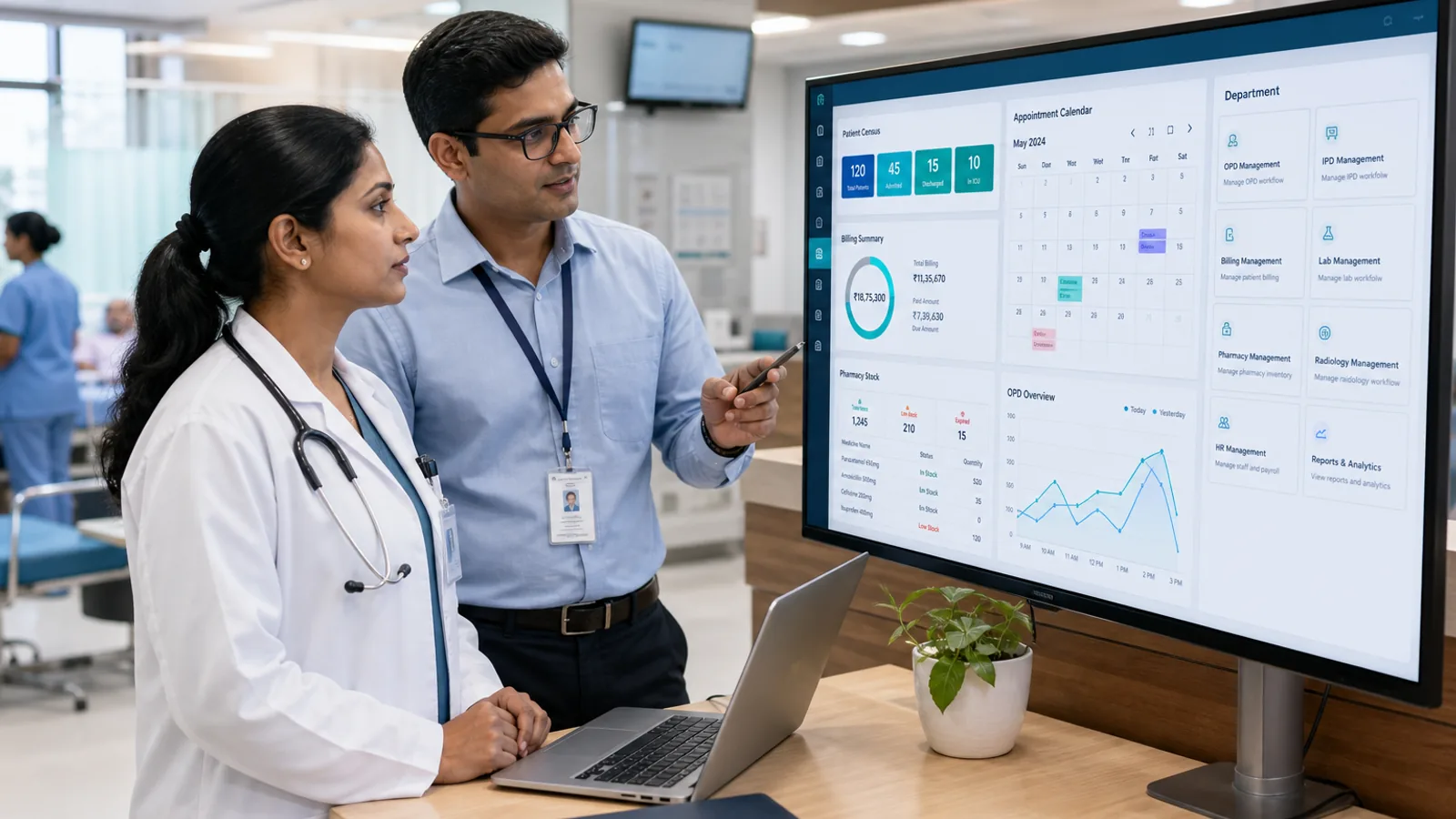
What is a Hospital Management System?
A Hospital Management System (HMS) is the foundation that enables hospitals to operate efficiently, deliver better patient care, and manage large volumes of data without errors.
This guide explains everything in detail—from basics to advanced features—so healthcare providers, administrators, and decision-makers can understand its real value.
A Hospital Management System is an integrated software solution designed to manage all aspects of a hospital’s operations. It connects different departments such as reception, doctors, laboratories, pharmacy, billing, and administration into one centralized platform.
In simple words, a Hospital Management System helps healthcare organizations:
- Store and manage patient records
- Schedule appointments
- Handle billing and payments
- Track inventory and medicines
- Improve communication between departments
Instead of relying on manual paperwork or disconnected systems, HMS ensures everything is managed digitally and efficiently.
Why Hospital Management System Is Important in India
India’s healthcare sector is one of the fastest-growing in the world, but it also faces several operational challenges:
- High patient volume in urban and rural hospitals
- Long waiting times
- Manual record-keeping
- Billing inefficiencies
- Lack of coordination between departments
A Hospital Management System addresses these issues effectively by introducing automation and digital workflows.
Key Reasons HMS Is Essential:
- Improves patient experience
- Reduces administrative workload
- Minimizes human errors
- Enhances hospital productivity
- Ensures compliance with healthcare regulations
In cities like Ahmedabad, Mumbai, Delhi, and Bangalore, both multi-specialty hospitals and small clinics are rapidly adopting HMS to stay competitive and efficient.
How Hospital Management System Works
Understanding how a Hospital Management System works helps in realizing its real impact.
Step-by-Step Process:
- Patient Registration — Patient details are entered into the system and assigned a unique ID.
- Appointment Scheduling — Patients book appointments with doctors based on availability.
- Doctor Consultation — Doctors access patient history and update diagnosis, prescriptions, and notes.
- Lab & Diagnostics Integration — Tests are scheduled, and reports are automatically updated in the system.
- Pharmacy Management — Prescriptions are directly sent to the pharmacy for dispensing medicines.
- Billing & Payments — Bills are generated automatically based on services used.
- Discharge & Reporting — Final reports and summaries are generated and stored digitally.
Every department accesses the same centralized system, ensuring seamless coordination and faster service delivery.
Core Modules of Hospital Management System
A Hospital Management System is built using multiple modules that work together to streamline operations.
1. Patient Management Module
This module handles:
- Patient registration
- Medical history
- Admission and discharge
- Patient tracking
It ensures that all patient-related information is stored securely and can be accessed instantly.
2. Appointment & Scheduling Module
- Online appointment booking
- Doctor availability tracking
- Automated reminders via SMS or email
This reduces waiting time and improves patient satisfaction.
3. Electronic Medical Records (EMR/EHR)
- Digital storage of patient records
- Diagnosis, prescriptions, and reports
- Easy access for doctors
This improves clinical decision-making and reduces duplication of tests.
4. Billing & Financial Management
- Automated billing system
- Insurance claim processing
- Payment tracking
This ensures accuracy and transparency in financial operations.
5. Laboratory Management System (LMS)
- Test scheduling
- Report generation
- Integration with patient records
This speeds up diagnostics and reduces manual work.
6. Pharmacy Management Module
- Medicine inventory tracking
- Prescription management
- Expiry alerts
It helps maintain proper stock levels and avoid wastage.
7. Inventory Management
- Tracks medical supplies
- Alerts for low stock
- Purchase management
Ensures smooth hospital operations without shortages.
8. HR & Staff Management
- Employee records
- Payroll and attendance
- Shift scheduling
Helps manage hospital staff efficiently.
9. Operation Theatre Management
- Surgery scheduling
- Resource allocation
- OT utilization tracking
Essential for hospitals performing surgeries regularly.
10. Reporting & Analytics
- Real-time reports
- Performance dashboards
- Data-driven insights
Supports better decision-making and planning.
Key Features of Hospital Management System
Modern Hospital Management Systems offer advanced features that go beyond basic operations.
Important Features Include:
- Centralized database
- Cloud-based access
- Multi-user access with roles
- Real-time data updates
- Automated workflows
- Mobile accessibility
- Data security and encryption
- Integration with third-party systems
These features help hospitals operate efficiently while maintaining high standards of care.
Benefits of Hospital Management System
The benefits of implementing a Hospital Management System are significant and long-lasting.
1. Improved Patient Care
- Faster services
- Accurate diagnosis with complete data
- Better communication
2. Reduced Paperwork
Manual records are replaced with digital systems, saving time and effort.
3. Increased Efficiency
Automation reduces repetitive tasks and improves productivity.
4. Accurate Billing
Eliminates billing errors and ensures proper revenue management.
5. Better Data Management
- Easy storage and retrieval
- Secure access
- Centralized database
6. Enhanced Communication
Departments can share information instantly, improving coordination.
7. Cost Reduction
- Lower operational costs
- Reduced manpower dependency
- Efficient resource utilization
8. Regulatory Compliance
Ensures hospitals follow healthcare standards and regulations.
9. Scalability
HMS systems can grow as the hospital expands.
10. Data Security
Advanced encryption and access control protect sensitive patient information.
Real-World Use Case in India
A multi-specialty hospital in Ahmedabad implemented a Hospital Management System to handle increasing patient demand.
Results Achieved:
- 40% reduction in patient waiting time
- 60% improvement in billing accuracy
- Faster access to patient records
- Better coordination between departments
This demonstrates how HMS can transform healthcare operations in real-world scenarios.
Challenges in Implementing Hospital Management System
Despite its benefits, implementing an HMS comes with certain challenges:
- High initial investment
- Staff training requirements
- Resistance to change
- Data migration issues
- Cybersecurity risks
However, these challenges can be managed with proper planning and support.
Future of Hospital Management Systems in India
The future of Hospital Management Systems is driven by advanced technologies.
1. Artificial Intelligence (AI)
- Predictive analytics
- Smart diagnosis support
- Automated workflows
2. Cloud Technology
- Remote access
- Cost-effective infrastructure
- Real-time updates
3. Telemedicine Integration
- Online consultations
- Remote patient monitoring
4. Internet of Things (IoT)
- Smart devices integration
- Real-time health tracking
5. Data Analytics
- Patient insights
- Hospital performance tracking
India is moving towards a fully digital healthcare ecosystem where HMS plays a central role.
How to Choose the Best Hospital Management System
Selecting the right HMS is critical for success.
Key Factors to Consider:
- Ease of use
- Customization options
- Scalability
- Integration capabilities
- Data security
- Vendor support
A well-chosen system can significantly improve hospital performance and patient satisfaction.
Conclusion
A Hospital Management System is no longer just an option—it is a necessity for modern healthcare in India.
It simplifies operations, improves patient care, reduces costs, and prepares hospitals for future challenges. From small clinics to large multi-specialty hospitals, HMS is transforming the way healthcare is delivered.
Hospitals that adopt HMS today are better equipped to handle tomorrow’s demands—efficiently, securely, and effectively.