What Is Pharmacy Management System?
A pharmacy management system is a digital software solution designed to manage and automate pharmacy operations. It helps pharmacists handle prescriptions, inventory, billing, reporting, patient records, medicine dispensing, and regulatory compliance from a centralized platform.
The system reduces manual work and simplifies complex pharmacy workflows. Instead of maintaining paper records or spreadsheets, pharmacies can use software to track medicines, process prescriptions, manage suppliers, and monitor sales in real time.
Modern pharmacy software is commonly used in:
- Retail pharmacies
- Hospital pharmacies
- Online pharmacies
- Clinic pharmacies
- Healthcare institutions
- Multi-store pharmacy chains
The primary goal of pharmacy management software is to improve operational efficiency while ensuring patient safety and medication accuracy.
Why Pharmacy Management Systems Are Important
Traditional pharmacy management methods often create problems such as:
- Prescription errors
- Incorrect medicine dispensing
- Inventory shortages
- Expired medicine losses
- Billing mistakes
- Slow customer service
- Difficulty managing compliance
A pharmacy management system solves these challenges through automation and centralized data management.
In today’s competitive healthcare environment, pharmacies must provide faster service, maintain accurate records, and ensure regulatory compliance. Pharmacy software helps achieve all these goals efficiently.
How Does a Pharmacy Management System Work?
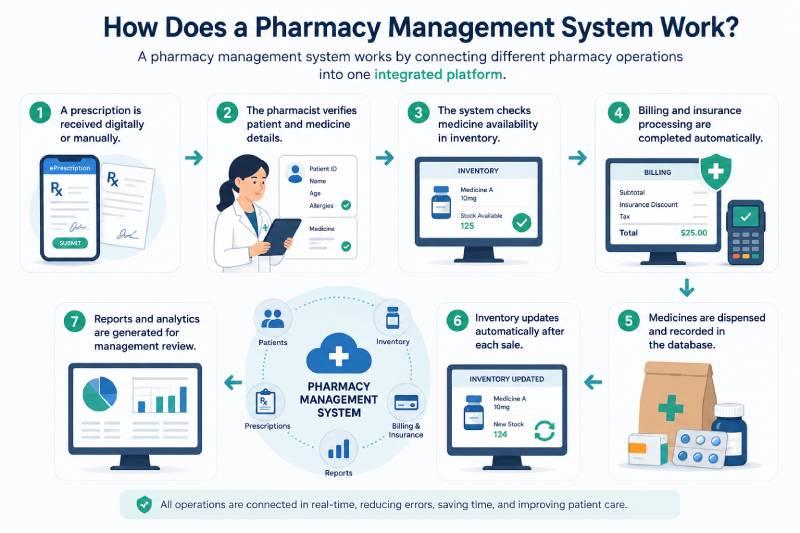
A pharmacy management system works by connecting different pharmacy operations into one integrated platform.
Here is a simple workflow:
- A prescription is received digitally or manually.
- The pharmacist verifies patient and medicine details.
- The system checks medicine availability in inventory.
- Billing and insurance processing are completed automatically.
- Medicines are dispensed and recorded in the database.
- Inventory updates automatically after each sale.
- Reports and analytics are generated for management review.
Advanced systems may also integrate with:
- Electronic Health Records (EHR)
- Hospital Management Systems (HMS)
- Laboratory systems
- Insurance platforms
- Barcode scanners
- Payment gateways
This integration improves data accuracy and eliminates duplicate work.
Key Features of Pharmacy Management System
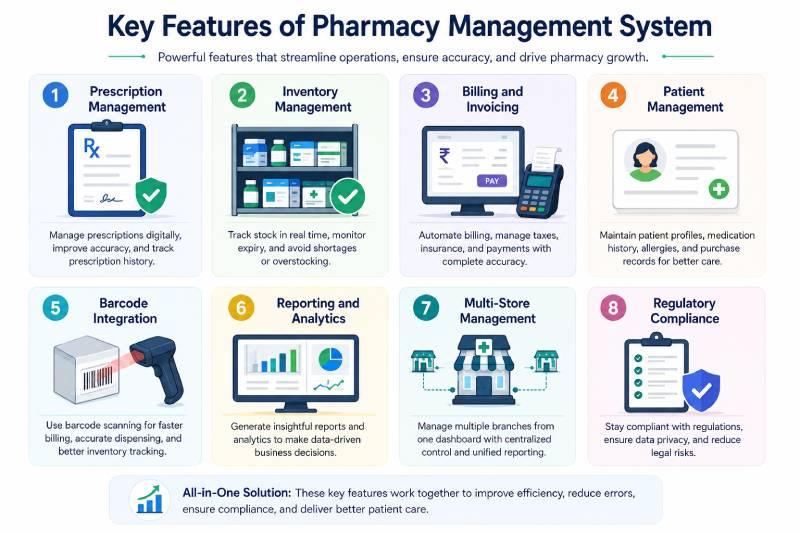
1. Prescription Management
Prescription management is one of the core functions of pharmacy software.
It helps pharmacists:
- Process prescriptions quickly
- Maintain digital prescription records
- Reduce handwriting interpretation errors
- Verify dosage instructions
- Track prescription history
E-prescription integration further improves accuracy and speeds up workflows.
2. Inventory Management
Inventory management ensures pharmacies always maintain optimal medicine stock levels.
The system helps with:
- Real-time stock tracking
- Expiry date monitoring
- Low stock alerts
- Batch tracking
- Supplier management
- Automatic stock updates
Proper inventory management reduces medicine wastage and prevents stock shortages.
3. Billing and Invoicing
Pharmacy management software automates billing processes to improve speed and accuracy.
Features include:
- GST/VAT billing
- Insurance billing
- Digital invoices
- Multiple payment methods
- Tax calculations
- Discount management
Automated billing minimizes human errors and improves financial transparency.
4. Patient Management
Patient management features help pharmacies maintain detailed customer records.
The system stores:
- Patient profiles
- Medication history
- Allergies
- Prescription history
- Doctor information
- Purchase records
This improves personalized healthcare services and medication safety.
5. Barcode Integration
Barcode scanning simplifies medicine identification and inventory tracking.
Benefits include:
- Faster billing
- Accurate medicine dispensing
- Reduced manual entry errors
- Improved inventory accuracy
Barcode systems are especially useful for large pharmacies and hospital environments.
6. Reporting and Analytics
Reporting tools help pharmacy owners make data-driven decisions.
Reports may include:
- Sales reports
- Profit analysis
- Inventory reports
- Expiry reports
- Supplier reports
- Customer trends
Analytics improve business planning and operational efficiency.
7. Multi-Store Management
Large pharmacy chains can manage multiple branches from one centralized dashboard.
This helps with:
- Centralized inventory tracking
- Unified reporting
- Branch performance analysis
- Remote monitoring
- Standardized workflows
8. Regulatory Compliance
Healthcare regulations are strict, especially in pharmaceutical operations.
A pharmacy management system helps maintain compliance with:
- Prescription regulations
- Drug safety standards
- Data privacy requirements
- Tax regulations
- Audit reporting
This reduces legal risks and improves operational transparency.
Types of Pharmacy Management Systems
Different pharmacies require different software solutions.
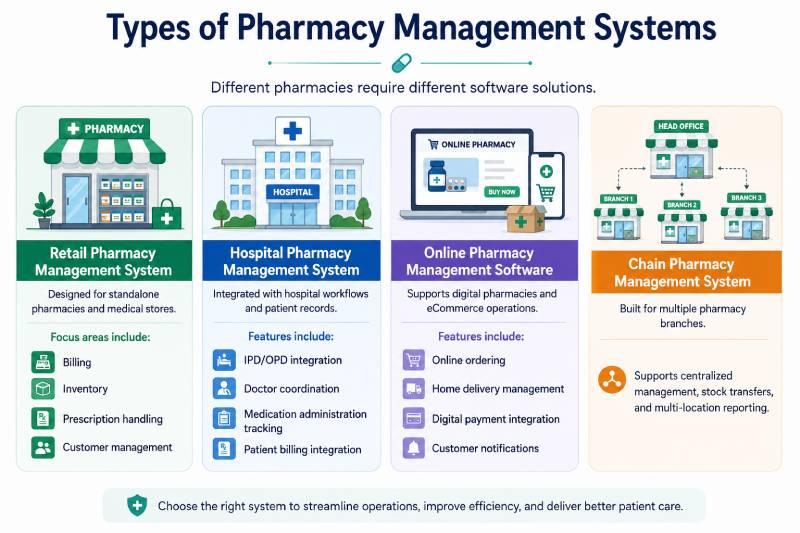
Retail Pharmacy Management System
Designed for standalone pharmacies and medical stores.
Focus areas include:
- Billing
- Inventory
- Prescription handling
- Customer management
Hospital Pharmacy Management System
Integrated with hospital workflows and patient records.
Features include:
- IPD/OPD integration
- Doctor coordination
- Medication administration tracking
- Patient billing integration
Online Pharmacy Management Software
Supports digital pharmacies and eCommerce operations.
Features include:
- Online ordering
- Home delivery management
- Digital payment integration
- Customer notifications
Chain Pharmacy Management System
Built for multiple pharmacy branches.
Supports centralized management, stock transfers, and multi-location reporting.
Benefits of Pharmacy Management System
The benefits of pharmacy management system go beyond automation. It improves both operational efficiency and patient care.
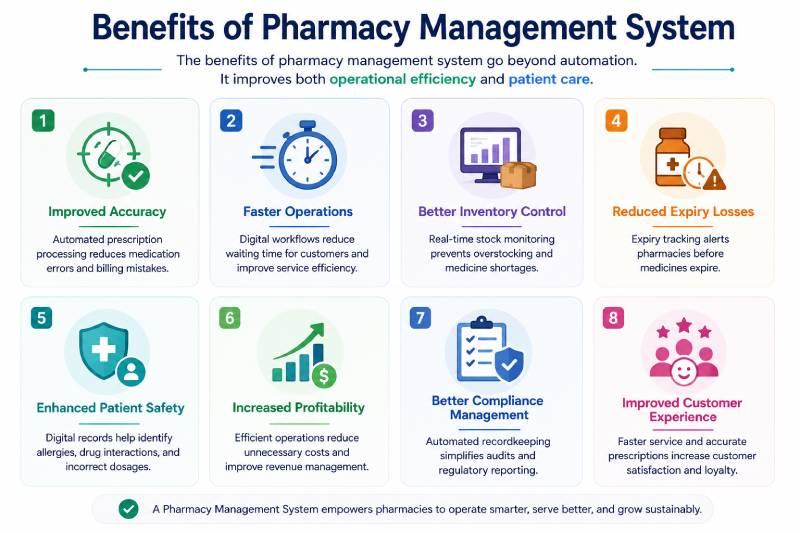
Improved Accuracy
Automated prescription processing reduces medication errors and billing mistakes.
Faster Operations
Digital workflows reduce waiting time for customers and improve service efficiency.
Better Inventory Control
Real-time stock monitoring prevents overstocking and medicine shortages.
Reduced Expiry Losses
Expiry tracking alerts pharmacies before medicines expire.
Enhanced Patient Safety
Digital records help identify allergies, drug interactions, and incorrect dosages.
Increased Profitability
Efficient operations reduce unnecessary costs and improve revenue management.
Better Compliance Management
Automated recordkeeping simplifies audits and regulatory reporting.
Improved Customer Experience
Faster service and accurate prescriptions increase customer satisfaction and loyalty.
Challenges Faced Without Pharmacy Management Software
Pharmacies relying on manual systems often struggle with several operational issues.
Manual Errors
Paper-based systems increase the risk of incorrect prescriptions and billing errors.
Inventory Mismanagement
Without automation, stock shortages and medicine wastage become common.
Slow Customer Service
Manual billing and prescription verification increase patient waiting time.
Data Security Risks
Physical records are harder to secure and manage.
Limited Reporting
Manual systems provide poor business insights and limited analytics.
Essential Modules in Pharmacy Management Software
A complete pharmacy management system typically includes multiple modules.
Purchase Management Module
Handles supplier orders and procurement workflows.
Sales Management Module
Tracks sales transactions and customer purchases.
Stock Management Module
Monitors inventory levels and medicine availability.
Accounts Management Module
Maintains financial records and accounting processes.
CRM Module
Improves customer relationship management and patient engagement.
HR and Staff Management
Tracks employee attendance, roles, and performance.
Pharmacy Management System Integration
Modern healthcare environments require connected systems.
Pharmacy software can integrate with:
- Hospital management systems
- Electronic medical records
- Insurance platforms
- Diagnostic labs
- Telemedicine platforms
- IoT-enabled devices
Integrated healthcare systems improve collaboration between departments and enhance patient care quality.
Cloud-Based vs On-Premise Pharmacy Management System
Cloud-Based Pharmacy Software
Cloud systems operate online and store data on secure remote servers.
Advantages
- Remote access
- Lower infrastructure cost
- Automatic updates
- Easy scalability
- Better disaster recovery
Limitations
- Internet dependency
- Subscription costs
On-Premise Pharmacy Software
Installed locally on pharmacy computers and servers.
Advantages
- Full data control
- No internet dependency
- Customization flexibility
Limitations
- Higher setup cost
- Maintenance responsibility
- Limited scalability
Future Trends in Pharmacy Management Systems
The pharmacy industry is evolving rapidly with new healthcare technologies.
Artificial Intelligence
AI helps predict medicine demand, automate workflows, and improve prescription verification.
IoT Integration
Smart devices monitor medicine storage conditions and automate inventory tracking.
Mobile Pharmacy Applications
Mobile apps improve prescription refills, medicine reminders, and customer engagement.
Telepharmacy
Remote pharmacy consultation services are becoming increasingly popular worldwide.
Data Analytics
Advanced analytics help pharmacies improve operational efficiency and patient outcomes.
How to Choose the Right Pharmacy Management System
Choosing the right pharmacy software depends on business size, operational needs, and future goals.
Consider Business Requirements
Identify whether the pharmacy is:
- Retail
- Hospital-based
- Online
- Multi-branch
Check Scalability
The software should support future business growth.
Evaluate Integration Capabilities
Ensure compatibility with healthcare systems and third-party tools.
Focus on User Experience
The software should be easy for pharmacists and staff to use.
Verify Security Standards
Patient data protection and compliance are critical.
Compare Pricing and Support
Look for transparent pricing and reliable technical support.
Best Practices for Pharmacy Management System Implementation
Successful software implementation requires proper planning.
Staff Training
Train employees to use the software effectively.
Data Migration Planning
Ensure secure transfer of existing pharmacy data.
Workflow Optimization
Customize workflows according to pharmacy operations.
Regular Updates
Keep the system updated for security and performance improvements.
Continuous Monitoring
Track software performance and operational improvements regularly.
Pharmacy Management System and Patient Care
Many people think pharmacy software only improves business operations, but it also significantly improves healthcare quality.
Benefits for patients include:
- Faster prescription processing
- Reduced medication errors
- Better medicine availability
- Improved treatment tracking
- Personalized healthcare support
Technology-driven pharmacies can deliver safer and more efficient healthcare experiences.
Common Mistakes Pharmacies Should Avoid
Choosing Software Only Based on Price
Low-cost systems may lack important features and scalability.
Ignoring Staff Training
Even the best software fails without proper user training.
Poor Data Backup Strategy
Regular backups are essential for protecting patient and business data.
Overlooking Security
Healthcare data security should always be a top priority.
Conclusion
Understanding what is pharmacy management system is essential for modern healthcare businesses aiming to improve operational efficiency, patient safety, and overall service quality.
A pharmacy management system automates daily pharmacy operations, simplifies inventory management, improves billing accuracy, and enhances prescription handling. It also supports compliance, business growth, and better customer experiences.
As healthcare technology continues to evolve, pharmacy software will play an even bigger role in digital healthcare transformation. Pharmacies that invest in modern management systems today will be better prepared for future healthcare demands.
Whether for retail pharmacies, hospitals, or online medical stores, the right pharmacy management software helps create a faster, safer, and more efficient pharmacy environment.