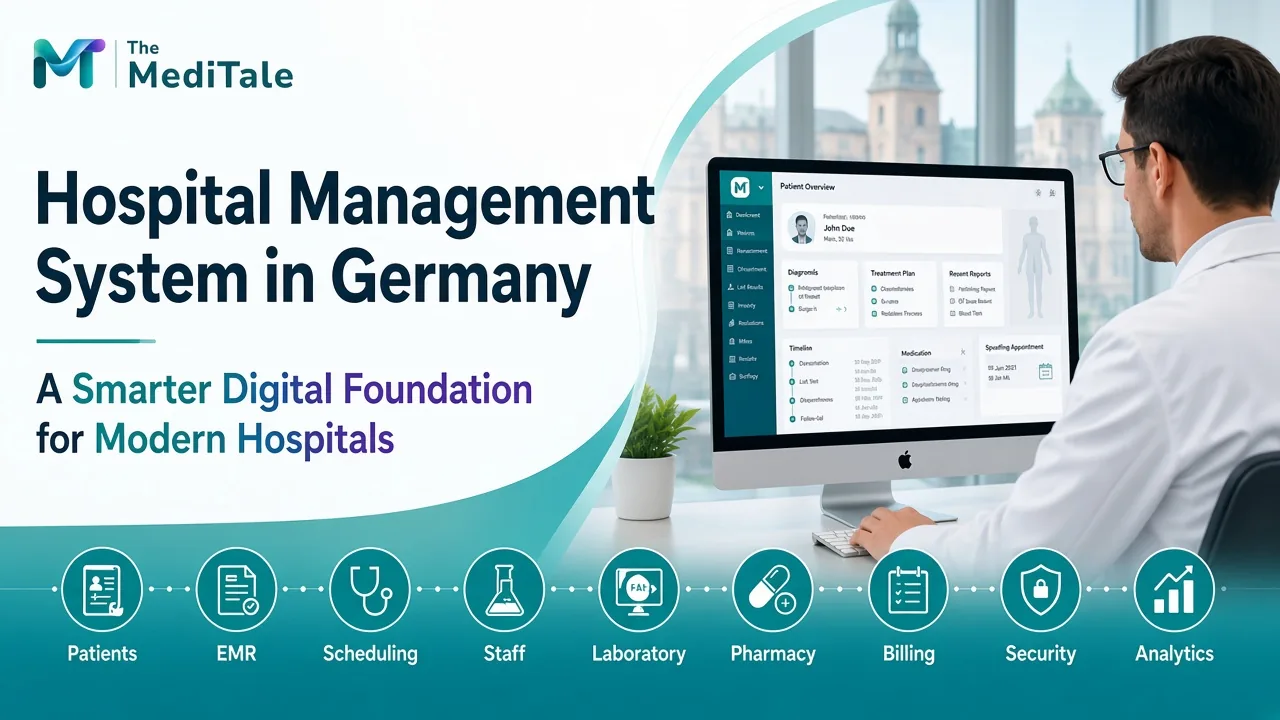
A Smarter Digital Foundation for Modern Hospitals
When these processes operate through disconnected applications or manual records, healthcare teams can spend unnecessary time searching for information, entering the same data multiple times and coordinating routine tasks.
A modern Hospital Management System in Germany provides a centralized digital environment for managing these activities while giving authorized teams access to the information they need.
The right system should do more than digitize paperwork. It should support clinical workflows, simplify administration, improve operational visibility and provide a reliable foundation for future digital healthcare initiatives.
Looking for the right hospital management solution? Request a personalized demo.
What Is a Hospital Management System?
A hospital management system is software that helps healthcare organizations coordinate clinical, administrative and operational activities through a connected digital platform.
Depending on the organization and implementation, it may include:
- Patient registration and admission
- Appointment scheduling
- Electronic medical records
- Clinical documentation
- Doctor and nursing workflows
- Laboratory management
- Pharmacy management
- Staff scheduling
- Hospital billing
- Inventory management
- Facility and asset management
- Telemedicine
- Reporting and analytics
In Germany, the term Krankenhausinformationssystem (KIS) is commonly used for hospital information systems. These systems can connect clinical and administrative processes and support information exchange between different areas of a hospital.
For healthcare providers, the objective is not simply to have more software. The objective is to create a connected workflow where information can move efficiently between the people and departments responsible for patient care and hospital operations.
Also read: What Is a Hospital Management System? A Complete Guide for Modern Healthcare in India
Why Hospitals in Germany Are Moving Toward Integrated Software
Healthcare organizations handle large volumes of sensitive information every day.
A single patient journey can involve registration staff, physicians, nurses, laboratory professionals, pharmacists, finance teams and administrators. Each department may generate or require different information.
Without an integrated digital workflow, this can result in:
- Repeated data entry
- Delayed access to information
- Communication gaps between departments
- Difficulties tracking resources
- Manual reporting
- Scheduling conflicts
- Inventory issues
- Administrative workload
A centralized Hospital Management System in Germany can bring these processes into one structured environment.
Instead of treating patient administration, clinical records, staff management and operational reporting as separate activities, hospitals can connect them around a common digital infrastructure.
This can be particularly valuable for hospitals dealing with multiple departments, growing patient volumes or increasingly complex administrative requirements.
Hospital Management Software in Germany for Connected Healthcare
Selecting Hospital Management software in Germany requires more than comparing feature lists.
A system may have dozens of modules, but if staff find it difficult to use or if it cannot fit existing workflows, adoption can become a challenge.
The most useful platforms are built around the practical needs of healthcare professionals.
1. Patient Management
Patient administration is at the center of hospital operations.
Digital patient management can help staff maintain structured records from registration and admission through appointments, treatment and discharge.
Important capabilities can include:
- Patient registration
- Patient profiles
- Medical history
- Appointment management
- Admission and discharge
- Visit records
- Patient communication
- Follow up scheduling
Having relevant information available through a centralized system can reduce unnecessary paperwork and make administrative processes easier to coordinate.
2. Electronic Medical Records
Clinical teams need accurate patient information when making treatment decisions.
Electronic medical records allow authorized professionals to access relevant patient information digitally instead of relying on scattered paper documentation.
A well designed system can organize information such as:
- Patient history
- Diagnoses
- Treatment information
- Clinical notes
- Laboratory results
- Prescriptions
- Consultation records
- Discharge documentation
The exact scope and configuration should be determined according to the hospital's clinical workflows, existing systems and regulatory requirements.
3. Appointment and Scheduling Management
Hospital scheduling can become complicated when multiple doctors, departments, treatment rooms and patient appointments need to be coordinated.
Digital scheduling tools can help teams manage availability and reduce scheduling conflicts.
Typical functions include:
- Doctor availability
- Patient appointments
- Department schedules
- Consultation slots
- Follow up visits
- Queue management
- Resource allocation
AI assisted scheduling can also be used to identify scheduling patterns and support more efficient allocation of available resources.
AI Powered Hospital Management Software in Germany
Artificial intelligence is changing how hospitals approach administration and operational planning.
However, using AI in healthcare requires a practical and responsible approach.
AI powered Hospital management software in Germany can assist with repetitive administrative activities, workflow analysis, scheduling support and operational forecasting without replacing professional medical judgment.
For example, AI can help analyze operational information and identify patterns that may otherwise require considerable manual effort.
Potential applications include:
Intelligent Scheduling
AI can analyze availability, appointment requirements and operational constraints to assist scheduling teams.
Documentation Assistance
AI can support certain documentation workflows by organizing information and reducing repetitive administrative work.
Operational Forecasting
Historical information can be analyzed to identify trends related to workload, staffing and resource requirements.
Workflow Prioritization
Large hospitals manage numerous tasks simultaneously. Intelligent systems can help teams identify activities requiring attention based on predefined rules and available information.
Management Analytics
AI supported analytics can help hospital leaders understand operational patterns and make more informed planning decisions.
The role of AI should remain clearly defined. Clinical decisions should continue to involve qualified healthcare professionals, appropriate governance and human oversight.
Hospital Staff Management and Rostering
Staff availability directly affects hospital operations.
Doctors, nurses, technicians, administrative employees and support teams work across different shifts and departments. Managing these schedules manually can become difficult as an organization grows.
Hospital management software can provide tools for:
- Shift planning
- Staff availability
- Leave management
- Overtime tracking
- Department allocation
- Workforce reporting
- Rostering
A centralized approach gives administrators a clearer picture of workforce availability and helps departments coordinate staffing requirements.
For larger healthcare organizations, workforce data can also contribute to longer term operational planning.
Laboratory Management
Laboratory services are closely connected to patient care.
Test requests, samples, results and reports need to be managed accurately and made available to the appropriate clinical teams.
A digital laboratory workflow can support:
- Test requests
- Sample tracking
- Laboratory processing
- Result recording
- Report generation
- Doctor access
- Laboratory records
Connecting laboratory workflows with other hospital processes can reduce duplicate data entry and improve access to relevant information.
Pharmacy and Inventory Management
Hospitals need reliable visibility into medicines and other medical inventory.
Manual inventory management can make it difficult to monitor stock levels, expiry dates, suppliers and usage.
Hospital software can help pharmacy teams manage:
- Medicine inventory
- Stock levels
- Expiry dates
- Suppliers
- Purchase records
- Inventory movement
- Usage reports
Better stock visibility can help administrators identify potential shortages and reduce avoidable inventory problems.
The same principle can apply to other hospital supplies and consumable items.
Hospital Billing and Financial Administration
Financial administration is another major component of hospital operations.
Billing teams may need to manage patient charges, services, payments, invoices and financial reports while coordinating information from different departments.
A connected management platform can support:
- Billing workflows
- Invoice management
- Payment records
- Revenue tracking
- Financial reporting
- Administrative documentation
Automating repetitive billing activities can reduce manual workload and help teams maintain more consistent records.
Financial modules should be configured according to the organization's business model, contractual arrangements and applicable German healthcare requirements.
Facility and Asset Management
Hospitals depend on medical equipment, buildings, rooms and other physical resources.
Managing these assets manually can make it difficult to maintain complete records and track maintenance requirements.
A digital facility management module can support:
- Asset records
- Maintenance schedules
- Service requests
- Equipment tracking
- Facility information
- Maintenance history
- Operational reporting
This provides hospital administrators with better visibility into the condition and availability of operational resources.
Interoperability Is Essential for German Healthcare
A hospital rarely operates with one software system.
Organizations may already have separate applications for laboratory services, radiology, pharmacy, finance, medical records and other specialized functions.
That makes interoperability an important consideration when selecting hospital software.
Modern hospital information systems need to work within a broader healthcare technology environment rather than becoming another isolated data source.
German healthcare organizations should evaluate how a proposed system can exchange information with existing applications and what standards, interfaces and integration methods are available.
Interoperability can help reduce information silos and create more consistent digital workflows across departments.
Data Protection and Security
Patient information requires strong protection.
When evaluating a Hospital Management System in Germany, organizations should examine how the platform approaches:
- User authentication
- Role based access
- Data encryption
- Audit trails
- Backup procedures
- Data retention
- System monitoring
- Access permissions
- Data processing responsibilities
German healthcare providers also need to consider applicable requirements under the GDPR and other relevant German and European healthcare regulations.
The specific compliance obligations depend on factors such as the organization, type of data, processing activities, hosting arrangements and system configuration.
For this reason, compliance should be assessed during the planning and implementation process rather than after deployment.
How to Choose the Best Software for Hospital Management
Searching for the Best Software for Hospital management can quickly become overwhelming.
Instead of selecting a platform because it has the longest feature list, hospital decision makers should evaluate how well the software fits their actual environment.
Start With Your Current Workflow
Map how patients, information and tasks move through the organization today.
Identify where teams experience delays, repeated data entry, manual work or communication problems.
Evaluate Integration Requirements
List the systems already being used and determine which integrations are essential.
Consider User Experience
Doctors and nurses cannot spend excessive time learning complicated administrative interfaces.
The system should make common tasks straightforward.
Examine Security Controls
Understand how user access, authentication, data protection, backups and auditability are handled.
Assess Scalability
Think beyond current requirements.
Ask whether the platform can support additional departments, users, facilities and services as the organization grows.
Look at AI Capabilities Carefully
AI should solve a specific operational problem rather than exist simply as a marketing feature.
Ask what data is used, what the AI actually does, where human review is required and how the organization can maintain appropriate oversight.
Consider Implementation Support
Successful digital transformation involves more than installing software.
Data migration, configuration, integrations, testing, staff training and ongoing support can all influence the success of implementation.
A Modular Approach to Hospital Digital Transformation
Not every healthcare organization needs every feature from day one.
A modular approach allows hospitals and clinics to prioritize the workflows that require attention first.
For example, an organization may begin with:
Patient Management → Clinical Records → Scheduling → Staff Management
and later introduce:
Laboratory → Pharmacy → Billing → Facility Management → Analytics → Telemedicine
This approach can make digital transformation easier to manage while allowing organizations to expand their technology environment as requirements evolve.
MediTale's healthcare platform includes modules covering areas such as patient management, staff rostering, laboratory management, pharmacy inventory, facility management and telemedicine.
Who Can Benefit From Hospital Management Software?
A well structured platform can support different types of healthcare organizations.
Hospitals
Coordinate clinical, administrative and operational workflows through a centralized environment.
Private Clinics
Manage appointments, patient records, billing and daily administrative processes.
Specialty Healthcare Providers
Configure workflows around the requirements of specific medical specialties.
Multi Location Healthcare Groups
Create more consistent digital processes across multiple facilities while maintaining appropriate access controls.
Growing Healthcare Organizations
Add modules and workflows as patient volumes, staff numbers and operational requirements increase.
What Makes a Hospital Management Platform Effective?
Technology is only one part of successful hospital digitalization.
An effective solution should bring together several elements:
Simple workflows + Reliable data + Secure access + Interoperability + Useful analytics + Human oversight
When these elements work together, healthcare professionals can spend less time managing disconnected administrative processes and more time focusing on their core responsibilities.
The objective is not to automate everything.
The objective is to automate appropriate tasks, organize information effectively and give professionals better tools for the work they already do.
Why Consider MediTale?
Healthcare organizations evaluating digital hospital solutions need a partner that understands both technology and practical healthcare workflows.
MediTale provides a healthcare management platform covering clinical administration, patient management, staff scheduling, laboratory workflows, pharmacy inventory, facility management, telemedicine and AI assisted capabilities.
The focus is on creating connected digital workflows that can be adapted to the needs of healthcare organizations rather than forcing every organization into the same operational model.
For organizations in Germany, the implementation discussion can include existing software, integration requirements, workflow priorities, data protection considerations and future digital initiatives.
Talk to our team about your hospital's requirements.
Build a More Connected Digital Hospital
Managing a modern healthcare organization requires reliable information, coordinated workflows and technology that works with people rather than creating additional complexity.
A well implemented Hospital Management System in Germany can connect patient administration, clinical workflows, staff management, laboratory services, pharmacy, billing and operational processes within a structured digital environment.
If your organization is comparing hospital management solutions, planning a new KIS environment or looking for AI assisted healthcare software, start by identifying the workflows that need the most attention.
Then evaluate technology based on usability, integration, security, scalability and practical value.
Ready to discuss your requirements?
Request a Demo | Speak With a Healthcare Technology Specialist